

Delta Lake helps Swedish businesses improve data reliability by supporting consistent data updates, transaction management, schema enforcement, and data recovery. When used with Databricks, it provides a reliable foundation for data engineering, analytics, and AI workloads, helping organisations maintain more dependable information for business decisions.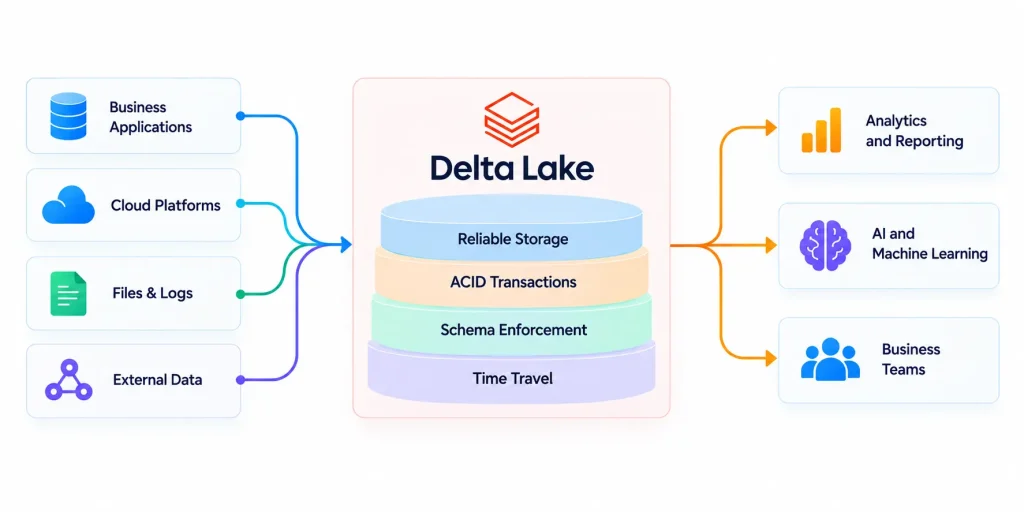
Businesses depend on accurate information to make decisions, manage operations, and understand changing customer needs. From financial records and inventory updates to production reports and customer transactions, data influences almost every part of modern business. However, collecting information from different systems does not guarantee that the information will remain accurate, consistent, or ready for analysis.
For many enterprises in Sweden, data reliability becomes harder to maintain as systems grow and business processes become more connected. Different applications may store information in different formats, while frequent updates can create inconsistencies between datasets. When teams discover these problems during reporting or analytics, they often spend valuable time investigating errors instead of using data to improve business performance.
Delta Lake addresses several of these challenges by adding reliability features to data lake storage. When organisations use Delta Lake within Databricks, they can manage data changes more consistently, validate incoming information, and recover earlier versions of datasets when necessary. These capabilities help businesses create a more dependable environment for analytics and AI.
For Swedish businesses looking to improve their data engineering practices, the goal is not simply to store more information. It is to ensure that the information remains trustworthy as it moves through different systems and workflows. Understanding how Delta Lake supports this process can help organisations make better decisions about their data architecture.
Why Is Data Reliability Important for Swedish Enterprises?
Reliable data helps businesses make decisions with greater confidence. When reports contain inconsistent figures or datasets lack important records, teams may question the accuracy of their analysis. This can delay decisions, increase manual work, and create unnecessary confusion between departments that depend on the same information.
Consider a Swedish manufacturing company that collects production data from several facilities. If one system records completed orders differently from another, management may receive conflicting reports about output, inventory, or delivery performance. Reliable data processes help the organisation identify inconsistencies and provide teams with information they can use more confidently.
The same challenge affects financial services, retail, logistics, and technology businesses. As companies connect more systems and introduce advanced analytics, the consequences of unreliable data become more significant. Establishing dependable data management practices helps businesses maintain consistency, improve reporting, and prepare their information for future applications.
What Is Delta Lake, and How Does It Work?
Delta Lake is an open-source storage framework that adds reliability and management capabilities to data lakes. It uses transaction logs alongside data files to help manage changes to datasets and maintain consistent views of information. This approach supports operations such as inserting records, updating existing information, and deleting data while preserving transaction consistency.
Traditional data lakes offer flexibility for storing large volumes of structured and unstructured information. However, without additional controls, organisations may face challenges when multiple processes update the same datasets or when incoming data does not match the expected structure. Delta Lake helps address these issues through features such as ACID transactions, schema enforcement, and time travel.
When used with Databricks, Delta Lake can support data engineering workflows that prepare information for reporting, analytics, and machine learning. Teams can process incoming records, validate datasets, and manage updates within a more reliable environment. The specific benefits depend on how organisations design their pipelines, configure their controls, and maintain their data systems.
How Does Delta Lake Help Prevent Data Inconsistencies?
Data inconsistencies often occur when several processes access or update the same information. A pipeline may fail halfway through a write operation, an application may introduce unexpected values, or separate jobs may attempt to modify the same dataset. Without appropriate transaction controls, these situations can leave downstream users working with incomplete or conflicting information.
Delta Lake supports ACID transactions, which help ensure that data operations complete consistently. If a transaction cannot complete successfully, the system can prevent an incomplete operation from appearing as a successful update. This helps maintain a consistent view of the dataset, even when businesses run complex data processing workflows.
For Swedish enterprises, transaction reliability becomes particularly useful when multiple applications depend on shared information. Finance teams, operations managers, and analytics professionals may all use data derived from the same source. By managing changes more consistently, organisations can reduce certain data-related risks and improve confidence in the information they use.
How Does Schema Enforcement Improve Data Quality?
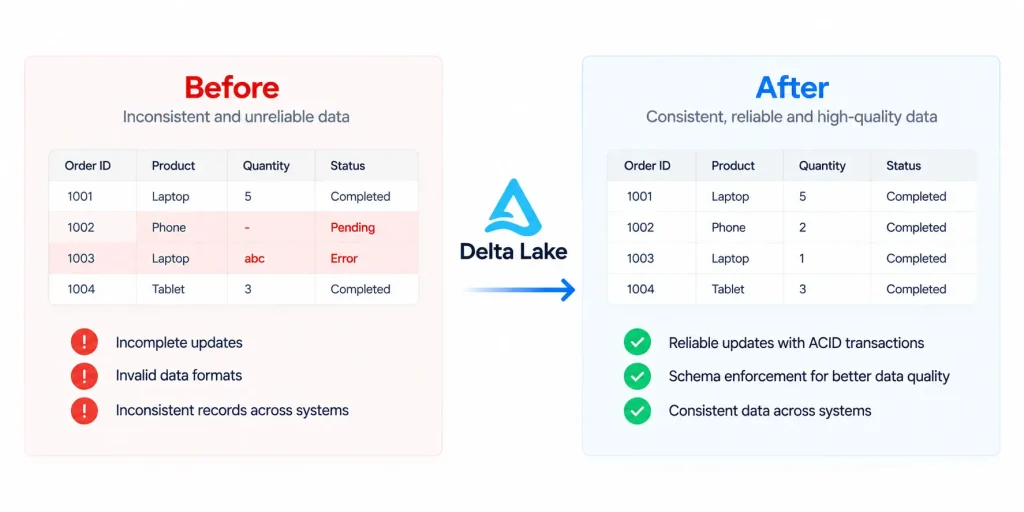
Data often arrives from systems that use different formats, field names, or structures. A source application might change a field from a number to a text value, while another source may omit a field that a downstream report expects. If these changes pass through a pipeline without validation, they can create errors that affect reporting and analytics.
Delta Lake provides schema enforcement to help check whether incoming data matches the expected structure before accepting a write. This allows organisations to identify incompatible records earlier in the data process rather than discovering problems after they affect reports or applications. Teams can then investigate the source of the issue and decide how to handle the incoming information.
Schema enforcement does not eliminate every data quality problem. A dataset can follow the correct structure and still contain inaccurate business values. However, combining schema checks with validation rules, monitoring, and clear data ownership helps Swedish businesses create more dependable data workflows.
How Can Delta Lake Help Businesses Recover From Data Errors?
Even well-managed data pipelines can experience mistakes. A transformation may apply an incorrect rule, an update may affect the wrong records, or a change in source data may produce unexpected results. When these issues affect important datasets, businesses need a practical way to investigate what happened and restore an appropriate version of the data.
Delta Lake supports time travel, which allows users to access previous versions of a table when the required historical data remains available. This capability can help teams compare changes, investigate unexpected results, and recover from certain data processing errors. It also provides a useful audit trail for understanding how a dataset has changed over time.
However, time travel does not guarantee that every previous version will remain available indefinitely. Retention settings, cleanup operations, and storage policies affect which historical versions organisations can access. Businesses should configure these settings carefully and maintain separate backups or recovery procedures where their operational requirements demand them.
How Does Delta Lake Support Databricks Data Engineering?
Reliable data engineering requires more than moving records between systems. Teams need to ingest information, transform it, validate its quality, and make it available for downstream applications. If any part of this process introduces errors, the impact can spread across reports, dashboards, and AI models.
Delta Lake helps data engineers manage the storage layer while Databricks provides capabilities for building and running data processing workflows. Together, they can support ingestion, transformation, and validation processes that help organisations maintain more consistent datasets. Teams can also use monitoring and testing to identify pipeline failures and investigate problems before they affect business users.
For organisations exploring Databricks Delta Lake solutions Sweden, the value comes from combining suitable architecture with dependable engineering practices. Delta Lake can improve the reliability of data operations, but teams still need to define validation rules, monitor workloads, manage permissions, and maintain clear processes for handling failures.
How Can Swedish Businesses Use Delta Lake in Different Industries?
Manufacturing and Supply Chain
Manufacturing businesses rely on information from production equipment, inventory systems, suppliers, and logistics platforms. Inconsistent records can make it harder to understand production performance or identify delays across the supply chain. Delta Lake can help manage updates to shared datasets more reliably, supporting analytics that depend on consistent operational information.
For example, a manufacturer may combine production records with inventory updates to improve planning. Reliable data processing helps reduce the risk of incomplete updates affecting reports, although the quality of the final analysis still depends on the accuracy of the source information and the design of the pipeline.
Financial Services
Financial organisations need dependable information for transaction analysis, reporting, and risk management. Data changes must follow clear rules, and teams need to investigate unexpected results when they occur. Delta Lake’s transaction management and historical versioning capabilities can support these requirements when organisations configure their data environment appropriately.
Retail and E-commerce
Retail businesses process information about sales, products, inventory, and customer activity. If datasets become inconsistent, teams may struggle to understand product performance or prepare reliable demand forecasts. Delta Lake can help maintain consistent datasets as new information arrives and existing records change.
Technology and Digital Services
Technology companies often process information from applications, customer platforms, and operational systems. Reliable data workflows help their teams maintain reporting accuracy and prepare information for analytics and machine learning. Delta Lake can support these workflows as part of a broader data engineering architecture.
What Should Businesses Consider Before Adopting Delta Lake?
Before introducing Delta Lake, organisations should assess their existing data architecture and identify the problems they want to solve. Some businesses may need stronger transaction handling, while others may benefit more from improved validation, monitoring, or pipeline design. Understanding the actual problem helps teams choose suitable capabilities instead of adding technology without a clear purpose.
Businesses should also review governance, access controls, retention policies, and operational requirements. Historical data can consume additional storage, and retaining every version indefinitely may not be appropriate for every workload. Teams should decide how long to retain data, who can access it, and how to recover important datasets when something goes wrong.
Finally, organisations should plan for ongoing monitoring and maintenance. Reliable data environments need regular checks for pipeline failures, unexpected schema changes, performance issues, and quality problems. A well-designed Delta Lake implementation combines the framework’s technical capabilities with clear ownership and processes that keep data dependable over time.
How Diggibyte Can Help Swedish Businesses Improve Data Reliability
Diggibyte helps organisations explore modern data engineering, analytics, and Databricks solutions that align with their business requirements. For businesses reviewing their data architecture, the first step is understanding where inconsistencies occur, which systems depend on the affected information, and what improvements would create the greatest operational value.
Through its data and AI expertise, Diggibyte can help businesses evaluate suitable approaches to data processing, integration, and platform modernisation. Organisations considering Delta Lake should assess how its capabilities fit their current workloads, governance requirements, and future analytics plans rather than treating it as a standalone fix for every data quality issue.
For companies looking for Databricks Delta Lake solutions Sweden, the focus should remain on building a dependable data environment that supports real business needs. With appropriate planning and implementation, organisations can improve the consistency of their data workflows and establish a stronger foundation for reporting, analytics, and AI.
Conclusion
Reliable data is essential for businesses that want to make informed decisions and build effective analytics solutions. As Swedish enterprises connect more applications and manage growing volumes of information, maintaining consistent and trustworthy datasets becomes increasingly important.
Delta Lake helps address several data management challenges through transaction support, schema enforcement, and access to historical table versions. When organisations combine these capabilities with sound data engineering practices, monitoring, and governance, they can create more dependable workflows for analytics and AI.
Looking to improve the reliability of your data environment? Connect with Diggibyte to explore Databricks solutions that help your business build dependable data pipelines and prepare for future analytics and AI needs.
Frequently Asked Questions
What is Delta Lake used for?
Delta Lake adds reliability and data management capabilities to data lakes. It supports transaction consistency, schema enforcement, and historical table versions, helping organisations manage data used for analytics and other workloads.
How does Delta Lake improve data quality?
Delta Lake supports schema enforcement, which checks whether incoming data matches the expected structure. Businesses can strengthen data quality further by combining these checks with validation rules, monitoring, and clear data ownership.
What is the difference between Delta Lake and a data lake?
A data lake is a storage environment for large amounts of data in different formats. Delta Lake adds transaction management and other reliability features to data stored in a lake, helping teams manage updates and maintain consistent datasets.
Can Delta Lake help businesses recover from data errors?
Delta Lake’s time travel feature can help teams access earlier table versions and investigate certain data errors, provided the required historical data remains available. Retention settings and recovery policies determine how far back teams can go.
How can Swedish businesses use Databricks Delta Lake solutions?
Swedish businesses can use Delta Lake as part of their data engineering architecture to manage updates, validate incoming data structures, and support reliable analytics workflows. The best approach depends on their existing systems, governance needs, and business objectives.