

Finnish businesses can improve data quality with Delta Lake by validating incoming data, managing updates consistently, identifying schema changes, and maintaining reliable datasets. When used with Databricks, Delta Lake supports dependable data engineering and analytics workflows, helping organisations make informed decisions and prepare their data for AI applications.
Businesses rely on data to understand their operations, serve customers, and make important decisions. Sales figures, production records, financial transactions, and customer information all influence how organisations plan their next steps. However, these decisions are only as reliable as the information behind them. When datasets contain missing values, duplicate records, or inconsistent formats, even a well-designed analytics system can produce misleading results.
For businesses in Finland, maintaining data quality becomes increasingly important as organisations connect more applications and adopt advanced analytics. Information may come from cloud platforms, enterprise applications, operational systems, and external sources, each following different data structures and update schedules. Without suitable checks, inconsistencies can spread across reporting systems and create additional work for teams that depend on accurate information.
Delta Lake provides capabilities that help businesses manage data changes and maintain more consistent datasets. When organisations use Delta Lake with Databricks, they can apply schema enforcement, manage transactions, and access previous table versions when the relevant historical data remains available. These features help data teams identify certain problems earlier and maintain more dependable information for downstream applications.
Improving data quality requires more than introducing a new technology. Businesses also need clear validation rules, responsible data ownership, and regular monitoring. By combining these practices with a suitable data architecture, Finnish enterprises can build stronger foundations for reporting, analytics, and artificial intelligence.
Why Is Data Quality Important for Finnish Businesses?
Reliable data helps businesses understand what is happening across their operations. When different teams use inconsistent figures, they may reach conflicting conclusions about performance, customer behaviour, or resource requirements. These differences can slow decision-making and create unnecessary discussions about which report or dataset contains the correct information.
Consider a Finnish manufacturing business that collects production records from several facilities. If one system records equipment identifiers differently from another, the organisation may struggle to combine production data with maintenance records. This can affect operational reporting and make it harder to identify patterns that could improve planning. Consistent data structures and validation checks help teams reduce these problems.
The same principle applies to financial services, retail, healthcare, and technology companies. Each industry has different data requirements, but all need dependable information to support their operations. Investing in data quality helps organisations reduce manual corrections, improve reporting confidence, and make better use of the information they already collect.
What Are the Most Common Data Quality Problems?
Data quality problems often develop gradually as organisations introduce new systems and expand their data operations. A dataset that worked well for one application may not meet the requirements of another, particularly when teams combine information from several sources. Without regular validation, these inconsistencies can remain hidden until they affect reports or business applications.
Some of the most common problems include missing records, duplicate entries, inconsistent date formats, unexpected values, and changes in data structure. For example, a customer identifier might appear in different formats across two systems, preventing the records from matching correctly. Similarly, a source application might introduce a new field that an existing data pipeline does not recognise.
Businesses should identify these problems at the point where they enter the data workflow whenever possible. Early detection makes it easier to investigate the source, apply suitable corrections, and prevent unreliable information from reaching downstream users. A structured data quality process also helps teams understand recurring issues instead of repeatedly fixing the same errors.
How Does Delta Lake Help Improve Data Quality?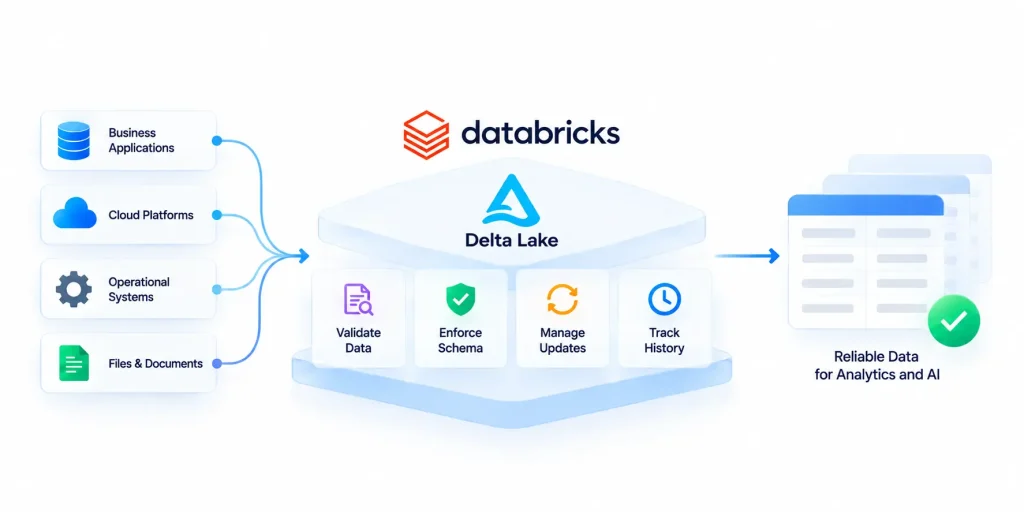
Delta Lake is an open-source storage framework that adds reliability and data management capabilities to data lakes. It supports features such as ACID transactions, schema enforcement, and time travel, helping organisations manage changes to datasets more consistently. These capabilities are useful when multiple workflows update information or when businesses need dependable data for analytics.
One important advantage is the ability to manage data updates through transactions. If a write operation fails, Delta Lake can prevent an incomplete transaction from appearing as a successful update. This helps maintain a consistent view of the affected dataset and reduces certain risks associated with interrupted processing jobs.
Delta Lake also supports checks on incoming data structures and access to previous table versions when those versions remain available. These features can help teams identify incompatible changes and investigate some data processing errors. However, they do not automatically correct inaccurate business information, so organisations still need validation rules, monitoring, and clear ownership of important datasets.
How Does Schema Enforcement Prevent Data Errors?
Data often arrives from systems that use different formats or structures. A source application might change a field from a numeric value to text, introduce a new column, or omit a field that a downstream process expects. If these changes pass through a pipeline without appropriate checks, they can cause processing failures or affect the accuracy of reports.
Delta Lake supports schema enforcement, which checks whether incoming data matches the expected structure before accepting a write. This helps organisations identify incompatible data earlier in the process rather than discovering the problem after it reaches a dashboard or analytical application. Teams can then investigate the change and decide whether to correct the source, adjust the schema, or handle the affected records separately.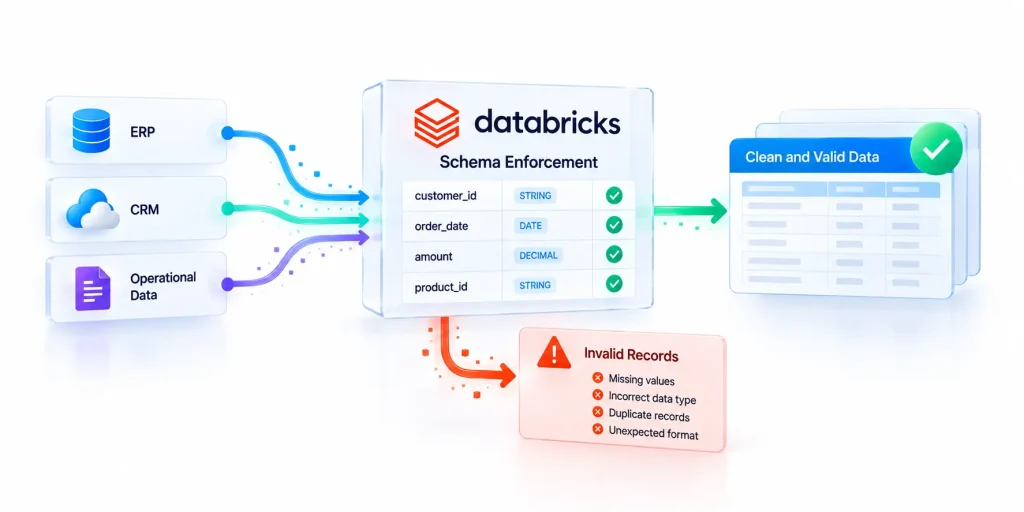
Schema enforcement is only one part of data quality management. A dataset may have the correct columns and data types while still containing inaccurate prices, invalid customer details, or incorrect business classifications. Finnish businesses should combine schema checks with business validation rules, duplicate detection, and regular data profiling to build a more complete quality process.
How Can Businesses Detect and Correct Data Quality Issues?
A dependable data quality process begins with defining what good data looks like. Businesses should identify which fields matter most, what values they expect, and which conditions make a record invalid. For example, a financial dataset may require a valid transaction date and a recognised account identifier, while a manufacturing dataset may need consistent equipment codes and acceptable measurement ranges.
Teams can then incorporate validation checks into their data engineering workflows. These checks can identify missing fields, duplicate records, unexpected values, and inconsistencies between related datasets. When a problem occurs, the pipeline should follow a defined procedure, such as rejecting an invalid record, isolating it for review, or correcting it when a reliable rule exists.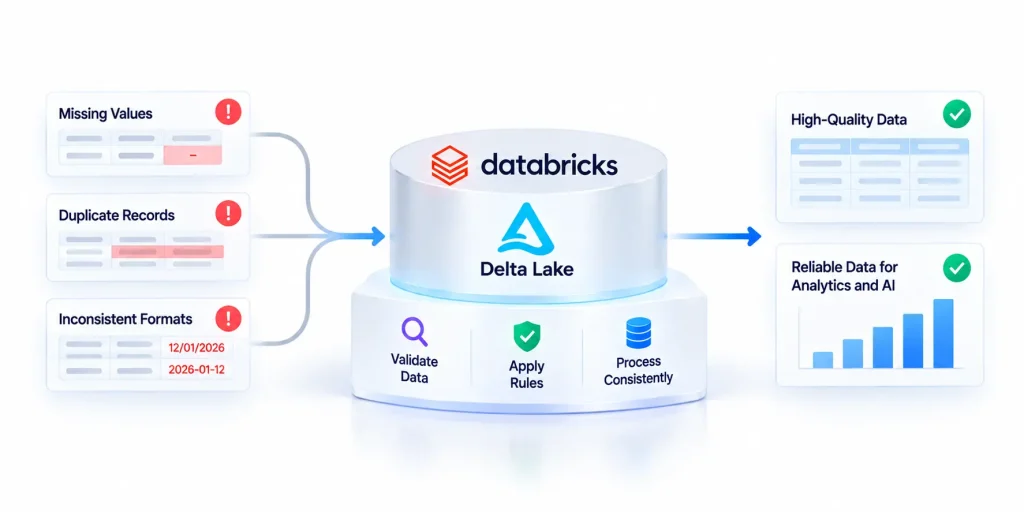
Monitoring helps organisations understand whether data quality is improving over time. Teams can track the frequency of errors, investigate recurring problems, and identify the source systems responsible for introducing them. By reviewing these patterns regularly, businesses can address underlying causes instead of relying on repeated manual corrections.
How Does Delta Lake Support Reliable Data Engineering?
Data engineering involves collecting information, processing it, and preparing it for reporting, analytics, and AI applications. Data quality problems can affect every stage of this process, especially when pipelines depend on information from multiple systems. Businesses need workflows that handle updates consistently and identify errors before they spread to other datasets.
Delta Lake can support these workflows by providing transaction management and schema enforcement for data stored in its tables. When combined with suitable pipeline design, validation checks, and monitoring, these capabilities help organisations maintain more dependable datasets. Teams can also use historical table versions to investigate certain changes, provided the necessary history remains available.
For Finnish enterprises exploring Databricks data engineering services Finland, the focus should be on improving the complete data workflow rather than relying on a single feature. Effective data engineering combines suitable architecture, reliable processing, clear validation rules, and ongoing maintenance. This approach helps businesses make better use of their information while preparing for more advanced analytical requirements.
How Can the Databricks Lakehouse Approach Improve Data Management?
A Lakehouse architecture combines aspects of data lakes and data warehouses to support data storage, processing, analytics, and AI workloads within a connected environment. This approach can help organisations manage different types of information while providing a consistent foundation for downstream applications. It also allows teams to organise data as it moves from raw inputs to datasets prepared for business use.
With Databricks Lakehouse solutions Finland, businesses can explore ways to connect data engineering and analytics workflows more effectively. For example, an organisation might ingest operational records, validate incoming information, and prepare curated datasets for reporting. Analysts can then work with these datasets without repeatedly rebuilding the same preparation steps for every report.
A Lakehouse architecture does not automatically guarantee high data quality. Organisations still need suitable access controls, validation rules, data ownership, and monitoring. When these practices form part of the overall design, businesses can create a more consistent environment for managing information and supporting future analytics and AI initiatives.
How Can Finnish Industries Benefit From Better Data Quality?
Manufacturing and Industrial Operations
Manufacturing companies depend on accurate production, inventory, equipment, and supplier information. Inconsistent records can make it difficult to understand production performance or identify operational problems. Reliable data quality checks help teams combine these sources more effectively and create more dependable reports for planning and analysis.
Financial Services
Financial organisations need consistent transaction records, customer information, and reporting datasets. Errors or inconsistencies can affect analysis and create additional work during reconciliation. Appropriate validation, access controls, and transaction management help these organisations maintain dependable information for their business processes.
Retail and Logistics
Retailers and logistics companies manage information about products, orders, inventory, deliveries, and customer activity. Duplicate records or inconsistent product identifiers can affect stock reporting and demand forecasts. Better data quality practices help teams maintain a clearer view of operations and make more informed decisions.
Technology and Digital Services
Technology businesses often combine information from applications, customer platforms, and operational systems. Maintaining consistent datasets helps teams improve reporting and prepare information for analytics and machine learning. A structured data quality process also makes it easier to investigate problems as new systems and data sources are introduced.
What Should Businesses Consider Before Adopting Delta Lake?
Before adopting Delta Lake, businesses should assess their existing data environment and identify the problems they want to solve. Some organisations may need stronger transaction handling, while others may benefit more from schema validation, improved monitoring, or better pipeline design. Understanding these requirements helps teams choose appropriate capabilities rather than introducing technology without a clear purpose.
Businesses should also review governance, retention, security, and recovery requirements. Historical table versions can help teams investigate certain data errors, but retention settings and cleanup operations determine how much history remains available. Organisations should establish suitable policies and separate backup or recovery procedures where their operational needs require them.
Finally, businesses should plan for ongoing maintenance and accountability. Data sources change, new applications are introduced, and business rules evolve over time. Regular testing, monitoring, documentation, and clear data ownership help teams maintain quality as the data environment grows. This ongoing effort is essential for keeping information useful and trustworthy.
How Diggibyte Can Help Finnish Businesses Improve Data Quality
Diggibyte helps organisations explore modern data engineering, analytics, and Databricks solutions that align with their business objectives. Improving data quality begins with understanding where inconsistencies occur, which systems depend on the affected information, and how those problems influence reporting or operational decisions. This assessment helps businesses identify practical improvements instead of treating every data issue as a technology problem.
For organisations considering Delta Lake, the right approach should account for existing data pipelines, source systems, validation requirements, and governance practices. Diggibyte can help businesses explore suitable data platform and engineering approaches based on these requirements. The aim is to create a dependable environment that supports the way the organisation actually uses its data.
Businesses looking for Databricks Delta Lake solutions Finland should focus on measurable improvements, such as fewer recurring data errors, more consistent reporting, and better visibility into processing issues. By combining suitable technology with clear data management practices, organisations can strengthen their analytics foundation and prepare for future AI initiatives.
Conclusion
Data quality affects how confidently businesses can use information to make decisions. For Finnish enterprises, maintaining consistent and reliable datasets becomes increasingly important as organisations connect more systems and expand their analytics and AI initiatives.
Delta Lake supports data reliability through transaction management, schema enforcement, and access to historical table versions when available. These capabilities can help businesses manage data changes and investigate certain errors, but they work best alongside sound validation rules, monitoring, governance, and clear ownership.
Ready to improve the quality and reliability of your data? Connect with Diggibyte to explore Databricks solutions that help Finnish businesses strengthen data engineering workflows and build a dependable foundation for analytics and AI.
Frequently Asked Questions
What is Delta Lake used for?
Delta Lake adds reliability and data management capabilities to data lakes. It supports transaction consistency, schema enforcement, and historical table versions, helping organisations manage data used for analytics and other workloads.
How does Delta Lake improve data quality?
Delta Lake supports schema enforcement and consistent data updates, helping teams identify certain structural problems and manage changes more reliably. Businesses should combine these features with validation rules and monitoring to detect inaccurate or incomplete information.
What is the difference between Delta Lake and a data lake?
A data lake stores large volumes of information in different formats. Delta Lake adds transaction management and other reliability features to data stored in a lake, helping teams manage updates and maintain consistent datasets.
Can Delta Lake help businesses recover from data errors?
Delta Lake’s time travel feature can help teams access earlier table versions and investigate certain data errors, provided the required history remains available. Retention settings and recovery policies determine which historical versions businesses can access.
How can Finnish businesses use Databricks for data quality management?
Finnish businesses can use Databricks with Delta Lake to validate data structures, manage updates consistently, and support reliable data engineering workflows. The right approach depends on their existing systems, data requirements, governance policies, and business objectives.