
Introduction
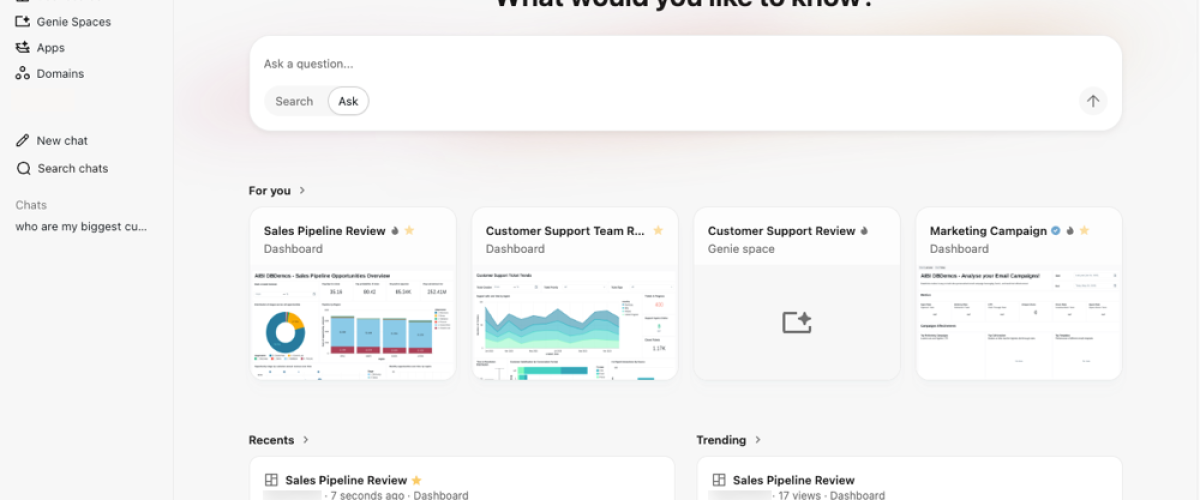
Genie is the Azure Databricks AI experience for users. It gives every user in your organization a single place to ask data questions in natural language, explore AI/BI dashboards, and run Azure Databricks Apps. Every answer is grounded in your organization’s data and governed through Unity Catalog.
Problem Statement
At Data + AI Summit 2026, Databricks framed Genie as more than a conversational analytics tool: it is becoming a “data-smart AI coworker” for every team. Genie One extends Genie from answering questions to producing documents, reports, and other artifacts, while connecting to the tools where work happens, including Slack, Microsoft Teams, and mobile.
But the more important story sits beneath the chat interface. Genie Agents make useful interactions reusable as scoped, shareable agents, while Genie Ontology provides a business-aware context layer that maps terms, entities, KPIs, and relationships to how an organization actually understands its data.
That points to the real anatomy of a data-smart AI coworker: the interface is only the visible layer; accuracy, context, reusable agency, and governance determine whether the coworker can actually be trusted. Databricks’ own architecture ties Genie to governed enterprise data and permissions through Unity Catalog, making the quality of the underlying business context as important as the model generating the answer.
The Governed Data Foundation Behind Genie
- Genie One: A simplified interface for business users to discover and interact with data assets.
- Genie Agents (GA): Save any Genie conversation as a reusable agent that inherits its sources, instructions, and behaviour, and can reason over unstructured data, not just tables and views.
- Genie Ontology: Genie Ontology is a live context layer Databricks announced at Data + AI Summit 2026. It is a self-improving knowledge graph that continuously learns your business from Databricks data, dashboards, queries, and 50+ connected apps, then powers Genie with more accurate answers, faster, at lower token cost.
- The Catch: The Ontology is automatic, but it can only map meaning that exists. Undefined metrics, ungoverned tables, and no semantic layer give you a confident coworker built on sand.
Genie Agents: the reusable layer
The piece that turns a clever chat box into something operational is Genie Agents, and these are now generally available.
A Genie Agent turns a useful Genie conversation into a reusable AI capability. Once saved, the agent carries forward the conversation’s memory, data sources, instructions, and behaviour, transforming a one-off analysis into something repeatable and shareable. Databricks positions Genie Agents as curated, domain-specific agents that can reason across both structured and unstructured data and take actions autonomously. They can also be created from a single prompt.
For an enterprise, that changes the equation from “someone in finance found a useful answer once” to “finance now has a reusable agent that can handle this class of questions consistently, using the same governed data and business context.”
The Genie Ontology
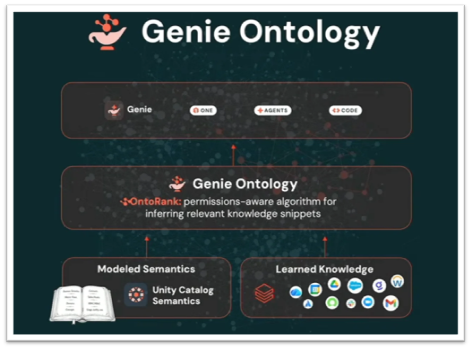
This is the piece we would pay the closest attention to—and the one most likely to be misunderstood—because the Genie Ontology is currently in **Public Preview**, not GA.
The Genie Ontology acts as an automatic context layer for Genie. Databricks describes it as extracting knowledge from tables, queries, dashboards, pipelines, and connected applications to build a continuously improving map of how an organisation defines and uses its data. In practical terms, it captures:
→ Metric definitions — including business terms and the calculations behind them.
→ Relationships — connecting concepts, metrics, tables, and teams.
→ Data authority — using PageRank-like weighting that considers the source of a definition, the authority of its author, how frequently an asset is used, its relationship to certified assets, and how recently it has been updated.
The goal is straightforward but important: give Genie enough business context to understand where to look, what to trust, and how to answer in a way that reflects the organisation’s actual definition of its data**. That is a significant step beyond an assistant simply finding a table that appears to match a question. The aim is for it to identify the source the organisation considers authoritative.
But there is an important caveat. The Ontology can map and learn from meaning that already exists; it cannot magically create a coherent semantic foundation where one does not exist. If metrics are poorly defined, tables are inconsistently governed, and teams disagree on the source of truth, the Ontology can end up mapping that ambiguity rather than eliminating it.
That is why the surrounding data foundation matters so much. The glossary, domains, governance hub, and semantic definitions in Unity Catalog provide the structured business context that the Ontology can build on. In other words, Genie’s intelligence is only as trustworthy as the meaning and governance underneath it.
Governed by Default?
Enterprise AI only scales when governance is built into the foundation. With Genie, Databricks takes a governance-first approach, embedding security and administrative controls directly into the platform rather than treating them as an additional layer.
Genie respects existing data permissions by default. Answers are governed by source-native access controls or Unity Catalog, ensuring users see only information they are already authorized to access. The Ontology operates within these existing permissions, so Genie cannot be used to circumvent an organization’s access policies or expose data through an alternative path.
Governance extends beyond data access. Through Unity AI Gateway, administrators can establish centralized controls over models, tools, MCP connections, and AI-related costs. This gives organizations a consistent way to manage how teams access and consume AI capabilities while maintaining visibility into usage and spend.
The same production principles also apply to Genie Agents. As organizations move from conversational analytics to agent-based workflows, evaluation, monitoring, budgets, and operational controls become critical. Genie is designed to operate within this broader governance framework, helping teams move from experimentation to production without sacrificing oversight.
For enterprise leaders and IT teams, this matters because deploying AI across an organization requires more than capable models. It requires confidence that the technology can operate securely within existing data policies, remain manageable as adoption grows, and provide administrators with the controls needed to govern its use.
Genie One brings these capabilities together through a comprehensive set of administrative and governance controls. By combining permission-aware access, centralized AI governance, and production-grade operational oversight, Databricks enables organizations to expand AI adoption while maintaining control over their data, models, tools, and costs.
Governance is therefore not a feature added around Genie—it is part of how Genie is designed to work.
How to get “Genie Ready”
Adopting Genie is primarily a foundation exercise—not a configuration exercise.
→ Define metrics and business terminology first.
Genie is only as reliable as the semantic context behind it. Establish certified metric definitions, business terms, ownership, and source-of-truth data in Unity Catalog before expecting consistent answers.
→ Get governance right before rollout.
Genie operates within your existing data permissions and access controls. Well-defined ownership, permissions, and data classification in Unity Catalog are essential to maintaining the right security boundaries.
→ Define and measure “good” before going live.
Build an evaluation set from real business questions. Measure accuracy, consistency, SQL correctness, and whether responses meet your organization’s expected standards—not just whether Genie can answer a question.
→ Treat action-taking as a production security boundary.
If a Genie Agent can invoke tools or perform actions, govern those capabilities explicitly. Review available tools, permissions, approval requirements, budgets, and policies just as you would for any production AI agent.
→ Start with the strongest semantic foundation.
Choose a domain where data ownership, definitions, and business logic are already mature. Prove value there, capture gaps, improve the foundation, and then expand to additional domains.
The key takeaway:
Genie doesn’t eliminate the need for a strong data foundation—it makes that foundation’s quality much more visible.
Clean semantics + strong governance + measurable evaluation = reliable Genie adoption.
Final Thoughts:
Our honest take on Genie One:
The accuracy is real, the GA of Genie One and Genie Agents is significant, and the Ontology may be the most strategically important piece because it makes your existing semantic and governance investments more valuable over time.
But Genie is not a shortcut to a strong data foundation. It works with the meaning, metrics, and governance you have already established.
The enterprises most likely to succeed with Genie will be those that:
→ Define their metrics and business terms clearly
→ Govern their data and catalog properly
→ Evaluate Genie against real business questions
→ Treat agent action-taking as a security decision
Do the foundation work, and Genie can become a genuinely valuable AI coworker.
Skip it, and you may end up with a very articulate way to be wrong at scale.