
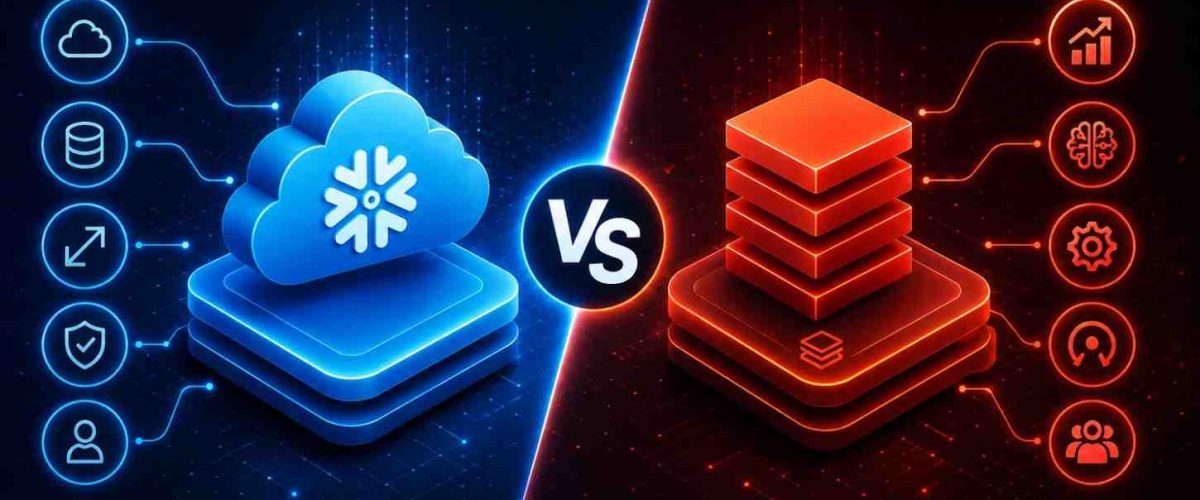
Businesses can successfully migrate from Snowflake to Databricks by developing a clear migration strategy, assessing workloads, improving data quality, implementing governance frameworks, planning integrations, and adopting a phased migration approach. A well executed migration helps organizations improve scalability, support AI initiatives, and create a unified data platform for future growth.
Modern data teams in Finland are under growing pressure to deliver faster insights, support artificial intelligence initiatives, and manage large volumes of business data with greater efficiency. As organizations move away from fragmented legacy systems, cloud data platforms have become essential for analytics, reporting, governance, and innovation. Two of the most discussed platforms in this space are Snowflake and Databricks.
Snowflake has built a strong reputation as a cloud data warehouse that simplifies data storage, reporting, and business intelligence. Databricks, on the other hand, offers a unified platform that supports data engineering, analytics, machine learning, and AI workloads. Both platforms have clear strengths, but the right choice depends on business goals, data maturity, workload complexity, and long term technology strategy.
For many organizations, the discussion is no longer only about choosing between two tools. It is about deciding which platform can support modern data needs now and future AI ambitions later. This is why many enterprises are exploring Snowflake migration to Databricks as part of their broader data modernization journey.
What Snowflake Does Well
Snowflake is widely known for its simplicity and strong cloud data warehousing capabilities. It allows organizations to store structured data, run SQL based analytics, and support business intelligence use cases efficiently. For teams focused mainly on dashboards, reporting, and traditional analytics, Snowflake can provide a reliable and user friendly environment.
Another strength of Snowflake is its separation of storage and compute, which helps teams manage workloads more flexibly. Business users and analysts can work with data using familiar SQL based approaches, making adoption easier for organizations that already rely heavily on structured reporting. This has made Snowflake a popular choice for companies looking to modernize data warehousing without adding too much operational complexity.
However, modern data requirements are expanding. Many organizations now need more than reporting and structured analytics. They want real time pipelines, machine learning, large scale data engineering, and AI driven applications. This is where the comparison with Databricks becomes more important.
What Databricks Does Well
Databricks is designed as a unified data and AI platform. It supports data engineering, data science, machine learning, analytics, and AI use cases within one environment. This makes it highly valuable for organizations that want to move beyond traditional business intelligence and create a stronger foundation for advanced analytics.
The platform supports structured, semi structured, and unstructured data, which gives data teams greater flexibility. Businesses can manage large scale data pipelines, build AI models, process streaming data, and support analytics workflows without relying on multiple disconnected tools. This unified approach helps reduce complexity while improving collaboration across teams.
For organizations in Finland that are investing in automation, predictive analytics, and AI enabled business processes, Databricks can offer a broader set of capabilities. Companies working with Diggibyte often evaluate Databricks when they want a platform that supports both current analytics needs and future AI strategies.
Data Warehousing vs Unified Data Platform
The biggest difference between Snowflake and Databricks lies in their core focus. Snowflake primarily serves as a cloud data warehouse, while Databricks functions as a broader data and AI platform. This difference matters because modern data teams often need to support diverse workloads across the organization.
If a company mainly needs SQL analytics, structured reporting, and business intelligence, Snowflake may fit well. If the organization needs advanced data engineering, machine learning, real time analytics, and AI development, Databricks often provides stronger flexibility. The decision depends on whether the business wants a warehouse focused platform or a more unified ecosystem.
This is one reason why companies consider Snowflake to Databricks migration when their data needs become more advanced. As workloads grow in complexity, businesses may require a platform that can support more than traditional reporting.
AI and Machine Learning Capabilities
Artificial intelligence is becoming a major priority for enterprises across Finland. Businesses want to use data for forecasting, automation, customer intelligence, fraud detection, operational improvement, and generative AI initiatives. These use cases require strong data engineering and machine learning capabilities.
Databricks has a clear advantage for AI and machine learning because the platform was built to support these workloads natively. Data scientists, engineers, and analysts can collaborate within the same environment, reducing handoffs and improving project speed. This makes Databricks suitable for organizations that want to build AI ready data platforms.
Snowflake has added AI and machine learning features over time, but Databricks remains stronger for teams that need deep machine learning workflows, model development, and advanced data processing. Businesses planning to migrate Snowflake to Databricks often do so because they want to strengthen their AI foundation.
Data Engineering and Pipeline Management
Data engineering is one of the most important areas for modern data teams. Reliable pipelines ensure that data moves from source systems into analytics and AI environments accurately and efficiently. Poor pipeline design can lead to data quality issues, delayed reporting, and reduced trust in analytics.
Databricks provides strong capabilities for data engineering, including large scale processing, workflow automation, streaming support, and flexible data transformation. These features help organizations manage complex data environments more effectively. Data engineers can build scalable pipelines that support both analytics and advanced AI workloads.
Snowflake also supports data transformation and pipeline workflows, but many complex engineering teams prefer Databricks when they need greater flexibility. During a Snowflake to Databricks migration, organizations often redesign their pipelines to improve performance, reliability, and scalability.
Governance and Security Considerations
Both Snowflake and Databricks offer governance and security capabilities, which are essential for modern enterprises. Organizations must protect sensitive information, control access, meet compliance requirements, and maintain trust in data assets. This becomes even more important when data supports AI models and business critical decisions.
Snowflake provides strong access control and data sharing features, making it effective for governed warehouse environments. Databricks also offers robust governance capabilities, especially for organizations that want to manage analytics, AI, and data engineering under one platform. Its governance features help teams manage permissions, lineage, quality, and collaboration across different data workloads.
Companies in Finland often seek Snowflake to Databricks consulting Finland when they want to evaluate governance needs before migration. Diggibyte helps organizations assess data access models, compliance requirements, and platform readiness so that governance remains central to the modernization process.
Cost and Performance Factors
Cost is an important consideration when comparing Snowflake and Databricks. Both platforms can deliver strong value, but costs depend on workload design, compute usage, storage needs, user activity, and optimization practices. A poorly configured environment on either platform can lead to unnecessary spending.
Snowflake can be cost effective for predictable SQL analytics and reporting workloads. Databricks can offer strong value for complex data engineering, machine learning, and multi workload environments. The key is to match platform capabilities with actual business use cases rather than choosing based on popularity alone.
Organizations planning Databricks data platform migration should also evaluate long term cost efficiency. Migration may require upfront effort, but a unified platform can reduce tool sprawl, simplify operations, and support broader business outcomes over time.
When Snowflake May Be the Better Choice
Snowflake may be the better fit for organizations that primarily need a cloud data warehouse for structured data, SQL analytics, and business reporting. If the data team focuses mainly on dashboards, financial reporting, and standard business intelligence, Snowflake can provide a simple and effective solution.
It may also suit organizations with limited data engineering complexity or those that want a platform with a relatively straightforward user experience for analysts. Teams already heavily invested in Snowflake may continue gaining value if their workloads remain warehouse focused.
However, companies should reassess the platform if they begin expanding into real time analytics, AI, machine learning, or large scale data engineering. As data strategies evolve, the limitations of a warehouse centric model may become more visible.
When Databricks May Be the Better Choice
Databricks may be the stronger choice for organizations that need a unified environment for data engineering, analytics, AI, and machine learning. It supports a wider range of workloads and helps technical teams collaborate more effectively across complex data initiatives.
For businesses with growing AI ambitions, Databricks provides a practical foundation for model development, advanced analytics, and data automation. It also helps reduce the need for multiple disconnected platforms, which can simplify architecture and improve long term scalability.
Organizations working with Databricks migration experts Finland often choose Databricks because they want to modernize more than a data warehouse. They want a platform that can support future innovation, business intelligence, and AI driven transformation.
How to Approach the Migration Decision
The decision to move from Snowflake to Databricks should begin with a careful assessment of business goals, current workloads, technical challenges, and future priorities. Organizations should identify what works well today, what creates friction, and what capabilities they will need in the next three to five years.
A migration roadmap should include workload assessment, data quality review, integration planning, governance design, user training, and performance validation. This prevents migration from becoming a simple lift and shift project and turns it into a true modernization opportunity.
Businesses that work with Diggibyte can approach migration with a structured plan that balances technical execution with business outcomes. The goal should not be only to move data, but to create a stronger data foundation for analytics, AI, and scalable growth.
Conclusion
Snowflake and Databricks both offer strong capabilities, but they serve different strategic needs. Snowflake is a reliable choice for cloud data warehousing and SQL based analytics, while Databricks provides broader support for data engineering, machine learning, AI, and modern analytics. For organizations in Finland, the better platform depends on whether the business needs a strong warehouse solution or a unified data and AI environment that can support long term innovation.
Companies evaluating a shift from Snowflake to Databricks should focus on business value, scalability, governance, and future AI readiness. Diggibyte helps organizations assess platform fit, plan migrations, and implement Databricks strategies that align with real business goals. Contact Diggibyte today to explore how your organization can modernize its data platform and build a stronger foundation for analytics and AI success.
FAQs
Why are businesses migrating from Snowflake to Databricks?
Organizations are migrating to Databricks to unify data engineering, analytics, machine learning, and AI workloads within a single platform.
How long does a Snowflake to Databricks migration take?
Migration timelines vary based on workload complexity, data volume, integrations, governance requirements, and business objectives.
What are the biggest migration challenges?
Common challenges include data quality issues, integration dependencies, governance requirements, performance optimization, and user adoption.
Is Databricks better for AI initiatives?
Yes. Databricks was designed to support machine learning, advanced analytics, generative AI, and large scale data engineering workloads.
Should businesses work with migration specialists?
Yes. Experienced migration specialists help reduce risks, accelerate implementation, improve governance, and optimize architecture for long term success.