
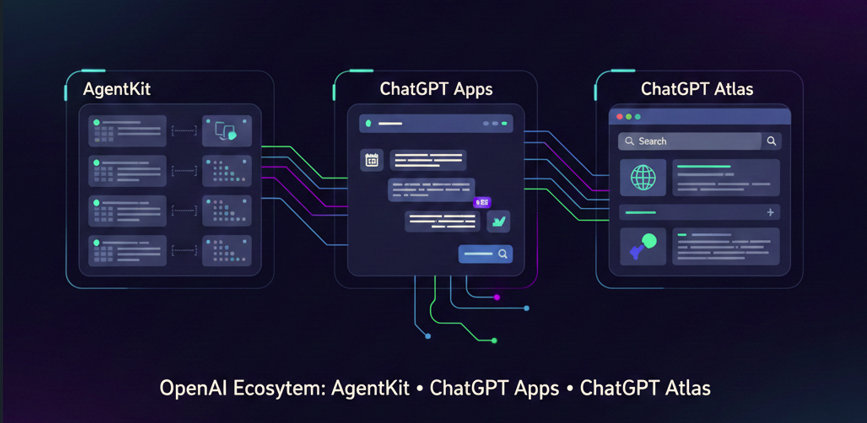
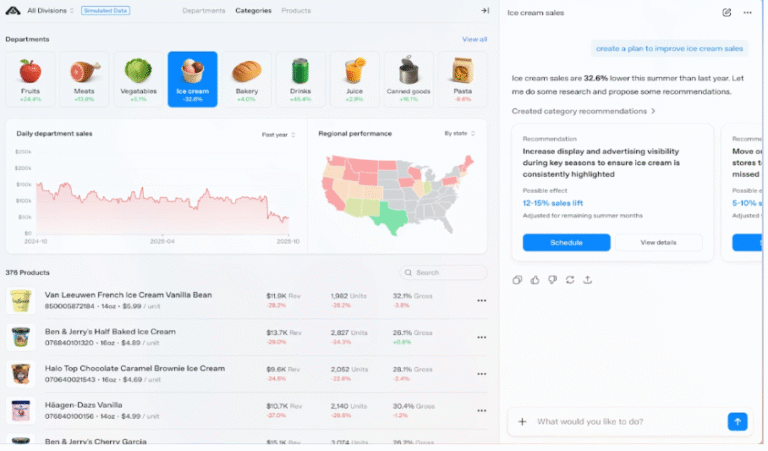
What if you could build enterprise-grade AI agents in under eight minutes instead of eight months? At OpenAI’s DevDay 2025, Sam Altman made this a reality live on stage. OpenAI CEO Christina Huang built an entire AI workflow and two AI agents in under eight minutes during the keynote. But that was just the opening act. OpenAI unveiled three game-changing products that fundamentally reshape how developers build, deploy, and distribute AI solutions: AgentKit for agent development, Apps SDK for embedding experiences in ChatGPT, and Atlas, an AI-native browser challenging Google Chrome’s two-decade dominance.
With ChatGPT reaching 800 million weekly active users, these announcements signal a shift from traditional software development to conversational, agentic experiences. The question isn’t whether AI will transform enterprise software; it’s whether your organization is ready to capitalize on it.
Why This Topic Matters?
OpenAI’s latest updates to the Agent Kit, ChatGPT Apps, and Atlas mark a major shift in how we interact with AI. This isn’t just another feature drop; it’s the start of ChatGPT evolving from a chat assistant into a full AI platform.
Until now, ChatGPT has mostly been a tool for generating content or answering questions. But with these new releases, developers and even non-coders can now build, customize, and deploy intelligent AI agents directly inside ChatGPT without needing to set up servers or external APIs.
What is OpenAI AgentKit?
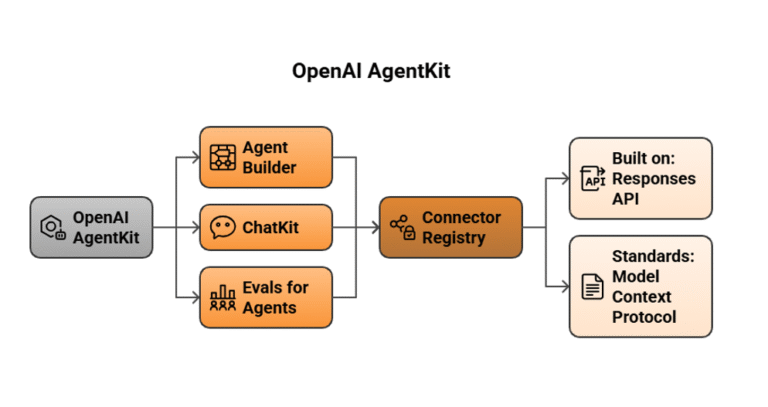
AgentKit is a complete set of building blocks available in the OpenAI platform designed to help developers take agents from prototype to production. It addresses the fragmentation that has plagued AI agent development by unifying four critical components:
- Agent Builder: A visual, drag-and-drop canvas for designing multi-step workflows.
- ChatKit: Embeddable chat interfaces for customized user experiences.
- Evals for Agents: Performance measurement tools with trace grading and automated optimization.
Connector Registry: Secure integration with internal tools and third-party systems.
What are ChatGPT Apps?
Apps in ChatGPT are a new generation of interactive applications that fit naturally into conversation, discovered when ChatGPT suggests them at the right time or is called by name. Unlike traditional apps that require switching contexts, ChatGPT Apps:
- Respond to natural language commands.
- Display interactive interfaces directly in chat.
- Share context through the Model Context Protocol (MCP).
- Enable seamless task execution without leaving the conversation.
What is ChatGPT Atlas?
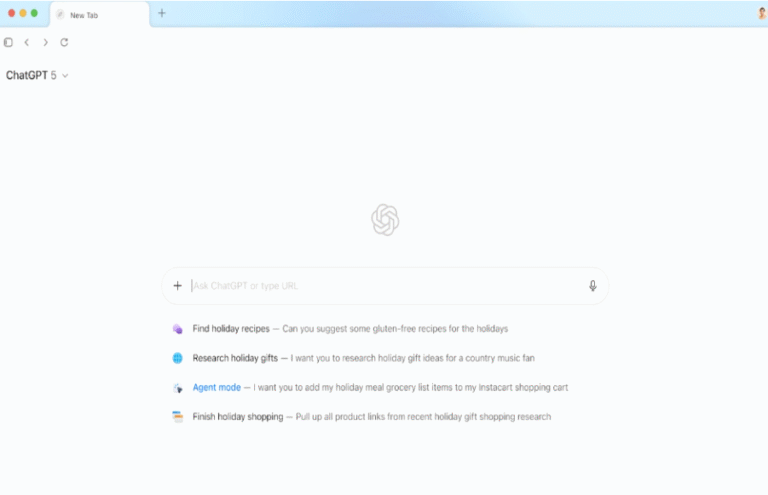
- ChatGPT Atlas is a new web browser built with ChatGPT at its core, putting AI assistance directly into the browsing experience. It represents OpenAI’s vision of a “super-assistant” that understands your work and helps achieve your goals across the entire web
Key Conceptual Comparison
Feature | AgentKit | ChatGPT Apps | ChatGPT Atlas |
Primary Purpose | Build AI agents | Embed apps in ChatGPT | AI-powered browsing |
Target Audience | Developers, Enterprises | App developers, SaaS companies | End users |
Distribution Model | API and SDK | Apps SDK (MCP-based) | Standalone browser |
Integration Approach | Visual workflow builder | In-conversation experiences | Browser-native AI |
Launch Status | Beta (Agent Builder) | Preview (Apps SDK) | Live on macOS |
Practical Implementation:
Step-by-Step Agent Building with Agent Builder:
Step 1: Access Agent Builder:
					# Navigate to OpenAI Platform
https://platform.openai.com/agent-builder
Step 2: Create Your First Workflow
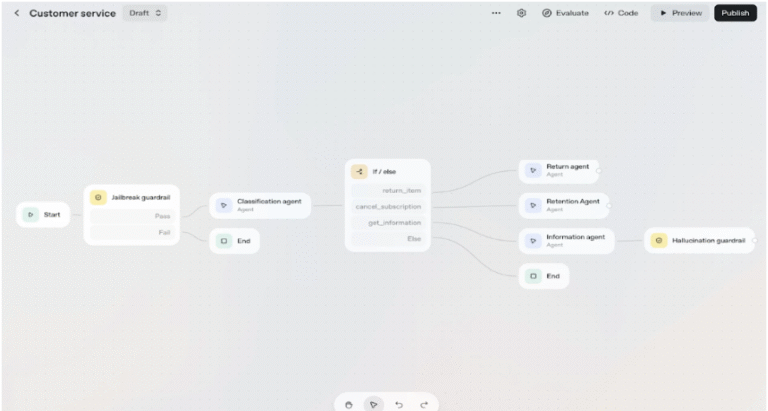
Agent Builder offers a visual drag-and-drop canvas for building agents, with multiple nodes to connect and code export capabilities.
Available Node Types:
- Start Node: Entry point with input variables.
- Agent Node: Core reasoning and tool execution.
- Guardrails Node: Safety filters (PII masking, jailbreak detection).
- State Node: Persistent data across workflow.
- Decision Node: Conditional logic routing.
Tool Node: External API/function calls.
Step 3: Add Evaluations
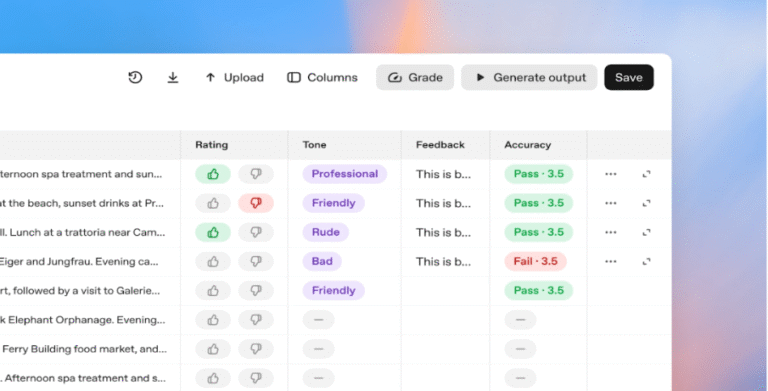
Evals for Agents introduces tools to measure AI agent performance, including step-by-step trace grading, datasets for individual components, and automated prompt optimization.
Step 4: Deploy with ChatKit
ChatKit makes it simple to embed chat-based agents that feel native to your product, with customization for theme and brand.
ChatGPT Atlas: The AI-Native Browser:
Key Features Breakdown
- Conversational Search
Users can ask questions or enter URLs to see faster, more useful results in one place, with tabs for search links, images, videos, and news.
- Sidebar Integration
The ChatGPT sidebar automatically has context for whatever’s on the screen, removing friction from copying and pasting text or dragging files and links into ChatGPT.
- Browser Memories
Browser memories let ChatGPT remember context from sites visited and bring that context back when needed, with users having complete control to view, archive, or delete memories at any time.
- Agent Mode
Agent mode in Atlas is available to Plus, Pro, and Business users, allowing ChatGPT to complete end-to-end tasks like researching meal plans, creating ingredient lists, and adding groceries to a shopping cart.
Use Case: Real Estate Search
In a demo of Zillow’s application, users could prompt ChatGPT in natural language to search for apartments in their area within a specific price range, with ChatGPT pulling up an interactive map showing options.
User: “Find me a 2-bedroom apartment in Austin under $2000/month near good schools and dog parks.”
ChatGPT Atlas:
- Invokes the Zillow app automatically.
- Displays an interactive map with 15 matching properties.
- User asks: “How close is the third option to a dog park?”.
- ChatGPT searches the web, combines with Zillow data.
- Provides detailed neighborhood analysis with commute times.
Industry Use Cases and Real-World Applications:
1. Financial Services: Due Diligence Automation
Challenge: Bain and Company needed to accelerate multi-agent due diligence frameworks for M&A transactions.
Solution: Using AgentKit’s evaluation platform, Bain achieved a 25% efficiency gain through more efficient dataset curation, improved prompt optimization, and automated trace validation.
Implementation:
Agent 1: Document Extraction → Pulls financial statements from PDFs
Agent 2: Financial Analysis → Calculates key metrics and ratios
Agent 3: Risk Assessment → Identifies red flags and compliance issues
Agent 4: Report Generation → Creates executive summary
Result: 50% reduction in development time, 30% increase in accuracy
2. Customer Support: Klarna’s AI Agent
Challenge: Handle more customer support requests without hiring more people.
Solution: Klarna built a support agent that handles two-thirds of all customer tickets using AgentKit’s ChatKit for seamless embedding.
Metrics:
- 66% ticket automation rate.
- 85% customer satisfaction.
- < 2-week implementation with ChatKit.
3. Education: LY Corporation Work Assistant
Challenge: Create collaborative workflows for engineers and subject matter experts.
Solution: LY Corporation built a work assistant agent with Agent Builder in less than two hours, dramatically accelerating the time to create and deploy agents.
4. Healthcare: Clinical Documentation Automation
Challenge: Physicians spend 2+ hours daily on electronic health record (EHR) documentation, leading to burnout and reduced patient face-time.
Solution: Clinical documentation agent using ChatKit embedded directly in the EHR workflow.
During Patient Visit:
- The agent listens to the conversation (with consent).
- Extracts key clinical information in real-time.
- Generates structured SOAP notes.
- Flags potential drug interactions.
- Physician reviews and approves (30 seconds).
Results:
– 85% reduction in documentation time
– 45 additional minutes per day for patient care
– 92% physician satisfaction
– 99.4% documentation accuracy
Future Trends & Roadmap: What’s Next for OpenAI’s Agent Ecosystem :
OpenAI’s DevDay 2025 wasn’t the finish line; it was the starting point of something much bigger. The new era of agentic AI is unfolding, and over the next two years, OpenAI’s ecosystem is set to transform how enterprises think about automation, intelligence, and collaboration.
Let’s explore the seven big shifts shaping the future of OpenAI’s AgentKit, Atlas, and the broader agent ecosystem.
- From Solo Agents to Swarms of Specialists
Today, most implementations run just a handful of agents, maybe two or three working in sequence. But by 2026, that’ll change dramatically. Enter Agent Swarms 10 to 50 specialized agents collaborating in parallel, coordinated by a triage-agent that manages who does what, when, and how efficiently.
Think of it like how Databricks evolved from single-cluster processing to multi-cluster auto-scaling. Similarly, OpenAI’s upcoming Agent Pools will spin up or shut down agents dynamically, based on real-time demand and performance.
What to watch for:
- Agent-to-agent communication protocols (beyond MCP)
- Distributed agent deployment across regions.
- Agent marketplaces for pre-trained specialists.
- Real-time agent performance dashboards
- From Assistance to Full Autonomy
Right now, agents still ask for human approval before doing high-impact tasks like sending emails or modifying data. But by 2027, that’s going to evolve into a world of graduated autonomy.
Here’s how it’ll progress:
- 2025: “ChatGPT, draft the email.”
- 2026: “ChatGPT, manage vendor communications.”
- 2027: “ChatGPT, handle Project X, make decisions within budget limits, and only escalate major issues.”
- ChatGPT Atlas: The Ambient Operating System
OpenAI’s Atlas is on track to become more than a browser-based workspace; it’s the foundation of ambient computing. Imagine a unified AI operating system that connects all your tools, applications, and devices, learning how you work and quietly making everything smoother.
What’s coming in 2026:
- Atlas Desktop Apps (Windows and Mac).
- Mobile Atlas with cross-device continuity.
- Atlas Cloud Workspace (a VS Code competitor).
- Atlas Enterprise Suite with compliance and deployment controls.
Sam Altman described this vision best: “ChatGPT isn’t a chatbot anymore, it’s a super-assistant that helps you achieve your goals.”
- Measuring Agent Reliability
As agent ecosystems grow, one key challenge is how to measure trust and performance.
OpenAI is already leading a to define global benchmarks like:
- ARS (Agent Reliability Score) – Uptime and consistency.
- TCR (Task Completion Rate) – % of tasks completed autonomously
These were first proposed in OpenAI’s “Evals for Agents” framework (Oct 2025), setting the foundation for standardized agent evaluation across industries.
- The ChatGPT App Store Moment
By Mid-2026, expect OpenAI to launch the ChatGPT Apps Marketplace, the “App Store” for AI. Creators and companies will be able to publish their own ChatGPT-based apps with flexible monetization:
- Free apps powered by OpenAI credits.
- Enterprise licensing models.
- Revenue-sharing for commerce-enabled apps (15–30%).
- Cross-Platform Agent Portability
OpenAI’s long-term strategy centers on open standards, making AgentKit agents portable across ecosystems like Microsoft Copilot, Google Gemini, and Anthropic Claude.
Conclusion: The Dawn of the Agentic Era
OpenAI’s October 2025 announcement of AgentKit, ChatGPT Apps, and Atlas represents more than product launches. They mark the shift from software we use to intelligence that works for us. What once required millions in investment and years of development now takes hours and minimal capital.
The strategic question isn’t whether AI agents will transform your industry—they already are. The question is whether you’ll be among the first movers building competitive moats measured in user interactions, iteration cycles, and network effects, or among the late majority playing catch-up in 2027.